Institutional Inisghts: Goldman Sachs "Jackson Hole, Buybacks & Mid Terms Seasonality"

US equities staged a modest, low-volume rally, led by Technology and Communication Services, while Energy lagged. European equities ended virtually flat. The core narrative remains systemic option volatility compression and quiet institutional activity.
US Indices: SPX +32bps to 7,677 (6/11 sectors positive; Tech +94bps, Comm Svs +77bps, Energy -166bps). DJIA +30bps to 53,577; NDX +66bps to 26,151 (SOX +1.4%).
Volatility Metrics: VIX dropped -2.5% to 15.45. Trailing 20-day option volumes are running ~20% below year-to-date averages.
Europe: 20-day realized volatility in the Euro Stoxx 50 (SX5E) printed at 9.5—the lowest level recorded in 2026.
Seasonality Pattern: Realized volatility is currently suppressed, but historical data shows October and November exhibit the highest median monthly realized volatility of the year, a dynamic especially pronounced during midterm election cycles.
Central Bank Focus: Jackson Hole Preview
Federal Reserve Chair Kevin Warsh speaks at 10:00 AM ET on Friday at the Jackson Hole Economic Symposium.
Expected Stance: Chair Warsh is likely to reiterate his commitment to the 2% inflation target.
Key Themes: He is expected to detail his strategy on Fed communications, touch on macro productivity growth (e.g., structural AI impacts), and discuss global economic shocks.
Forward Guidance: While acknowledging recent disinflationary prints, he is unlikely to offer explicit policy rate guidance, preferring deliberate opacity over forward telegraphing.
Fixed Income: Long-End Buybacks & Yield Dynamics
Treasury buybacks provide supply absorption at the long end, though macro fundamental drivers retain primary control over long-yield direction.
Supply Absorption: US Treasury long-end buybacks will absorb roughly 30% of gross 20-year and 30-year UST issuance, effectively maintaining a stable supply share (~10Y+) among private holders.
Macro Drivers: Buybacks serve as structural plumbing support but do not resolve core fiscal or global macro risks.
Yield Channel: Lower Treasury yields continue to move in tandem with falling energy prices, pointing to broader macro disinflation—rather than balance-sheet mechanics—as the main anchor for yields across the curve.
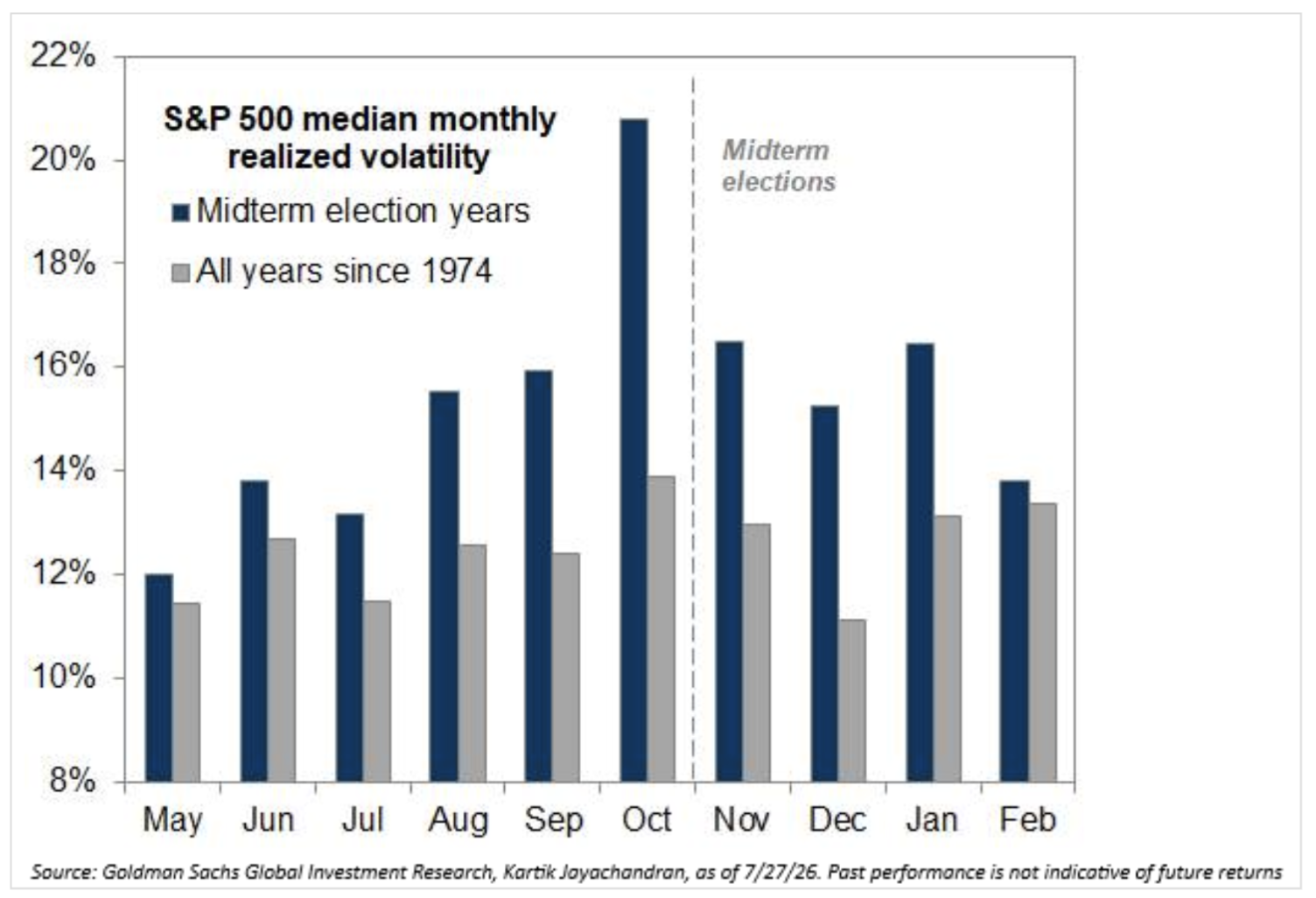
Midterm election years introduce a well-documented volatility dynamic: market uncertainty spikes heading into October/November as investors price in policy gridlock, legislative shifts, and administration tailwinds. Once the election passes, equity markets historically stage a strong "relief rally" accompanied by sharp volatility compression.
Here is how institutional traders structure portfolios to capture this seasonal regime shift.
1. The Seasonal Playbook: Phased Volatility Positioning
Phase | Volatility Tendency | Tactical Objective | Core Strategy |
Late Q3 – Pre-Election (Aug–Oct) | Implied & Realized Vol Ramping Up | Buy cheap volatility / Hedge downside | Long Volatility Structures (Straddles/Strangles, VIX Call Calendars) |
Election Week (Early Nov) | Implied Vol Peak / IV Crash | Capitalize on IV crush | Neutralize Vega, Short Event Volatility |
Post-Election (Nov–Dec) | Realized Vol Drop / Sector Rally | Long upside exposure | Call Options, Long Equity (Midterm Year Relief Rally) |
2. Core Derivatives & Options Tactics
A. Pre-Election Volatility Accumulation (Long Volatility)
VIX Call Calendars: Buy October/November VIX calls financed by selling short-dated September VIX calls. This captures the upward slope of the VIX futures curve as political headline risk intensifies.
SPX Long Straddles/Strangles: Target expirations running 1–2 weeks after Election Day (e.g., mid-November 2026). Buying straddles in late August or September—when implied volatility is suppressed—allows traders to capture both the delta movement and the vega expansion leading up to voting day.
B. The Post-Election "IV Crush" Harvest
Shorting the VIX Futures Term Structure: Once election results stabilize, the political risk premium collapses instantly. Traders sell near-term VIX futures or enter Short Iron Condors on the S&P 500 to collect elevated post-event premium.
Ratio Calendar Spreads (Sell Oct/Nov IV, Buy Dec IV): Exploit the steep volatility drop-off between November (event risk) and December (seasonal Santa Claus rally).
3. Sector & Cross-Asset Rotations
Sector Divergence Strategies
During midterms, specific sectors face regulatory and policy overhangs:
Healthcare & Energy: Highly sensitive to congressional balance-of-power shifts. Long sector-specific straddles capture large moves once legislative control becomes clear.
Defense & Financials: Typically rally on gridlock scenarios (where major legislative overhauls stall).
FX & Rates Expression
Long USD Volatility (USD/Pair Strangles): Cross-currency pairs often absorb macro policy shifts. Long-dated strangles on EUR/USD or USD/JPY offer defined-risk exposure to fiscal policy surprises.
Rates Volatility (MOVE Index / UST Options): Election outcomes heavily dictate fiscal spending expectations. Options on 10-year Treasury futures (TY) benefit from term-premium adjustments post-election.
Disclaimer: The material provided is for information purposes only and should not be considered as investment advice. The views, information, or opinions expressed in the text belong solely to the author, and not to the author’s employer, organization, committee or other group or individual or company.
Past performance is not indicative of future results.
High Risk Warning: CFDs are complex instruments and come with a high risk of losing money rapidly due to leverage. 68% and 74% of retail investor accounts lose money when trading CFDs with Tickmill UK Ltd and Tickmill Europe Ltd respectively. You should consider whether you understand how CFDs work and whether you can afford to take the high risk of losing your money.
Futures and Options: Trading futures and options on margin carries a high degree of risk and may result in losses exceeding your initial investment. These products are not suitable for all investors. Ensure you fully understand the risks and take appropriate care to manage your risk.
Patrick has been involved in the financial markets for well over a decade as a self-educated professional trader and money manager. Flitting between the roles of market commentator, analyst and mentor, Patrick has improved the technical skills and psychological stance of literally hundreds of traders – coaching them to become savvy market operators!