FTSE Flat as Iran Risk and Soft Jobs Data Stall Momentum
FTSE Flat as Iran Risk and Soft Jobs Data Stall Momentum
London’s FTSE 100 traded roughly flat on Tuesday, rotating between marginal gains and losses as investors stayed cautious amid rising U.S.-Iran tensions, limited fresh catalysts and a mixed UK labour-market report. The benchmark tried to stabilise after recent weakness, but there was little conviction behind the move.
Geopolitics remained the dominant risk. The 60-day Middle East ceasefire agreement has expired, and Washington has rejected an extension. Iran warned of a strong response to any fresh attacks and said it is preparing to shift to a “fully offensive” military posture. That kept markets wary, supported oil-linked names and discouraged broad risk-taking.
Energy and defensive-growth names helped offset losses elsewhere. RELX, BP, BT Group, Whitbread, Sage, Vodafone, Experian, IG Group, Auto Trader, Shell, JD Sports, Computacenter and Centrica gained between 1% and 2%. BP and Shell benefited from the elevated oil-risk backdrop, while RELX, Sage, Experian and Auto Trader continued to attract buyers looking for quality and resilient earnings.
BHP gained modestly after reporting a 9% increase in annual net profit, though the reaction was restrained as the broader mining sector remained under pressure. Investors were reluctant to chase the stock higher while metal prices and China-demand signals remain uneven.
The weaker side of the market included miners, property, technology trusts and rate-sensitive names. Polar Capital Technology Trust dropped more than 3%, while Halma, Endeavour Mining, Fresnillo, Antofagasta, Land Securities, Barratt Redrow and Lion Finance fell between 1.5% and 2%. Barclays, Scottish Mortgage, Diploma, Croda, Metlen Energy & Metals, Tesco, Persimmon, British Land and Babcock also moved lower.
The pressure on housebuilders and property names reflected the unsettled rate outlook. Stronger Q2 GDP has made it harder for markets to fully dismiss the possibility of further Bank of England tightening, while sticky inflation risks remain tied to oil and wages. That combination is uncomfortable for real estate, construction and long-duration equity names.
HgCapital Trust eased about 1% after announcing it would invest around £20 million through its manager Hg in Nourish Care, a nutritional diet consulting platform. The deal was not enough to offset the broader caution toward investment trusts and private-market vehicles.
The day’s key domestic release was the UK labour-market report. The Office for National Statistics said the unemployment rate remained at 4.9% in the three months to June, unchanged from the previous period and above expectations for a decline to 4.8%.
The headline figure masked mixed details. Employment rose by 84,000 in the three months to June, below the Bloomberg consensus forecast of 130,000 and well below stronger expectations for a 175,000 gain. On the surface, that suggests labour-market momentum is still subdued.
But the composition of employment growth was more encouraging. Employee numbers increased by 157,000, while self-employment fell by 50,000. Full-time employment rose by 96,000, while part-time employment edged lower. That marks an improvement from much of the past year, when job growth was disproportionately driven by self-employment rather than more stable employee roles.
Still, the unemployment details were less reassuring. Many forecasters had expected the three-month unemployment rate to fall because March’s elevated 5.3% single-month reading was dropping out of the rolling calculation. Instead, a rise in the single-month unemployment rate to 5.4% in June offset April and May readings of 4.7% and 4.6%, leaving the headline rate unchanged.
More timely payroll data pointed to weaker labour demand. HMRC payrolled employment fell by 13,000 in July after a revised 13,000 decline in June. Payroll employment has now fallen for six consecutive months and is almost 70,000 lower than at the start of the year.
That matters for the Bank of England. The PAYE data suggest the labour market is cooling through weaker hiring rather than widespread layoffs, with employee inflows remaining below outflows. For policymakers, that is consistent with a softer employment backdrop, but not necessarily a sharp downturn.
The labour data therefore offered something for both sides of the rate debate. Softer employment growth and falling payrolls support the BoE’s patient stance. But unemployment has not fallen, wage data remain the key missing piece, and geopolitical energy risks could still push headline inflation higher.
Wednesday’s CPI release is now the main event. Headline inflation is expected to rise to around 3.0% year-on-year, from 2.6%, largely because of the Ofgem price-cap increase. Lower petrol prices and possible food disinflation may provide some relief, while core inflation is expected to soften modestly. If core and services inflation cool, the BoE can look through the headline rise. If not, rate-hike risk could return quickly.
Finish Line: The FTSE 100 ended Tuesday close to flat as investors balanced oil-supported gains in BP and Shell, strength in RELX, Sage and Experian, and modest support from BHP against losses in miners, property, housebuilders and technology trusts. The UK labour report was mixed: unemployment held at 4.9%, employment rose less than expected, and payrolls fell for a sixth straight month, but employee and full-time jobs improved. With the Middle East ceasefire expired and CPI due Wednesday, investors had little reason to take aggressive positions..
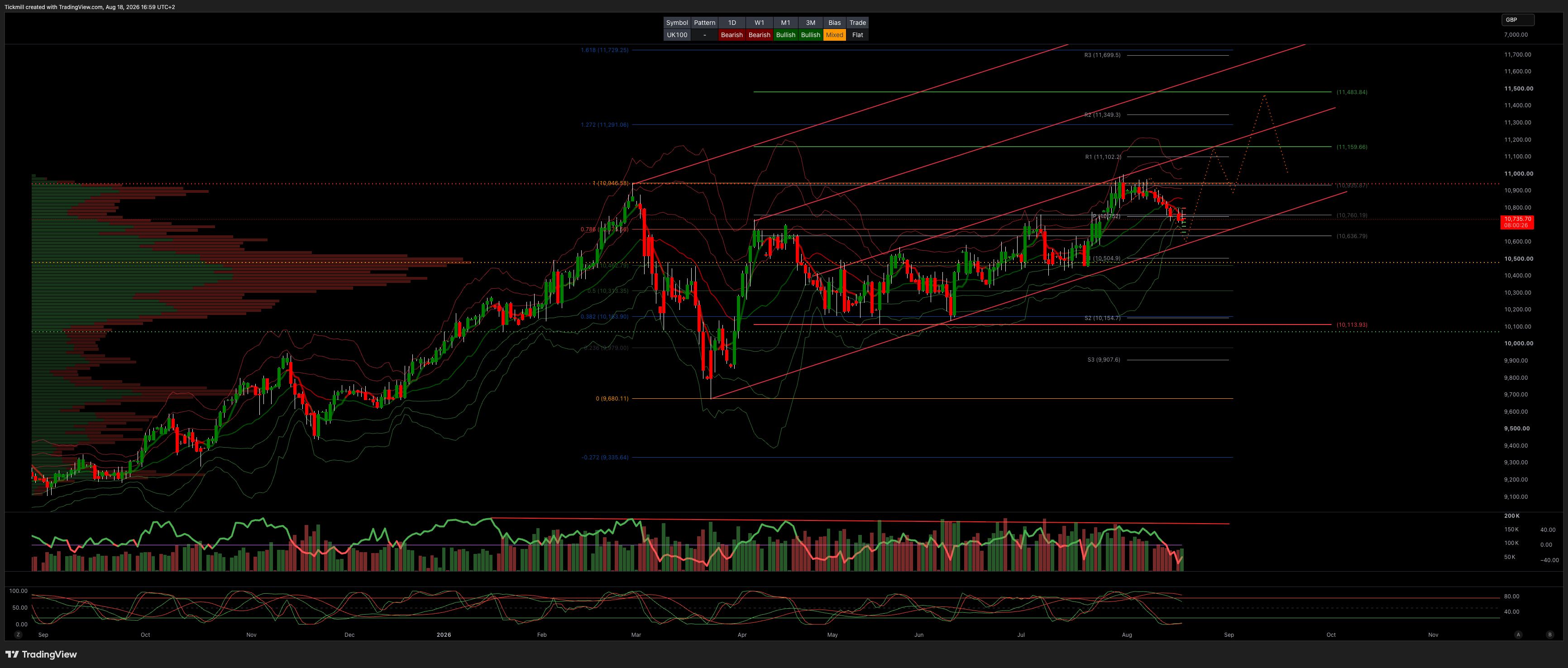
TECHNICAL & TRADE VIEW – FTSE100
Daily VWAP Bearish
Weekly VWAP Bearish
Above 10700 Target 11150
Below 10400 Target 9500
Disclaimer: The material provided is for information purposes only and should not be considered as investment advice. The views, information, or opinions expressed in the text belong solely to the author, and not to the author’s employer, organization, committee or other group or individual or company.
Past performance is not indicative of future results.
High Risk Warning: CFDs are complex instruments and come with a high risk of losing money rapidly due to leverage. 69% and 73% of retail investor accounts lose money when trading CFDs with Tickmill UK Ltd and Tickmill Europe Ltd respectively. You should consider whether you understand how CFDs work and whether you can afford to take the high risk of losing your money.
Futures and Options: Trading futures and options on margin carries a high degree of risk and may result in losses exceeding your initial investment. These products are not suitable for all investors. Ensure you fully understand the risks and take appropriate care to manage your risk.
Patrick has been involved in the financial markets for well over a decade as a self-educated professional trader and money manager. Flitting between the roles of market commentator, analyst and mentor, Patrick has improved the technical skills and psychological stance of literally hundreds of traders – coaching them to become savvy market operators!